
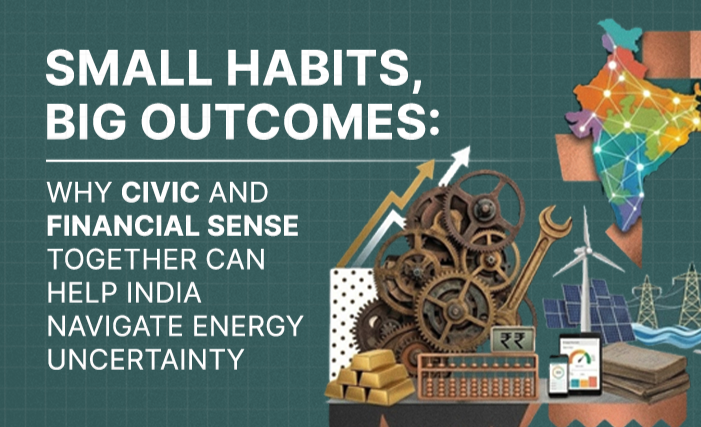
In a world where everything feels amplified, it is easy to overlook the role of individual action. Crises often appear macro and distant, something beyond our control. But the gap between perception and reality is often wider than we think.
Recent volatility in energy prices, driven by geopolitical tensions and supply disruptions, has brought this into sharp focus. Fuel prices rise, LPG costs adjust, logistics becomes expensive, and gradually, everyday expenses begin to shift.
For me, the more important question is this. How do we respond as individuals?
I believe the answer lies in the intersection of civic sense and financial sense. Resilience is not built by policy alone. It is also shaped by everyday decisions.
The Hidden Cost of Everyday Choices
India consumes over 5 million barrels of oil every day, most of it imported. This means global price shocks quickly translate into domestic impact.
But consumption is not just industrial. It is also behavioural.
A car left idling longer than necessary. Multiple short trips that could be combined. Appliances running when not needed. These actions seem small in isolation, but when multiplied across millions, they create a significant cumulative effect.
I see this as a pattern problem. When patterns are inefficient, outcomes follow. When patterns improve, outcomes improve as well.
Civic sense extends beyond keeping spaces clean or following rules. It also includes how responsibly we use shared resources like energy.
Simple habits such as carpooling, maintaining tyre pressure, reducing unnecessary fuel use, and switching to energy efficient appliances can make a measurable difference. Studies indicate that such changes can reduce energy consumption by close to 10 percent.
This is shared responsibility in action. Not enforced, but collectively practiced.
And this is where financial sense naturally aligns. Lower energy consumption leads to direct savings and better resource allocation. When people recognize this link, behaviour begins to shift.
When People and Policy Move Together
Governments play a critical role through subsidies, duty adjustments, and investments in renewable energy. But real acceleration happens when public behaviour aligns with policy direction.
We have seen this with the adoption of LED lighting in India. Scale was achieved not just through availability, but through widespread acceptance.
The same principle applies today to energy efficiency and responsible consumption.
I believe the most effective transitions are not imposed. They are embraced.
A More Conscious Way Forward
Energy volatility is not a one time event. It is likely to recur as global dynamics evolve. The real question is how prepared we are to navigate it.
Preparation does not always require sweeping changes. Often, it begins with awareness.
The focus is not on austerity. It is on intent. Doing more with less. Planning better. Making smarter choices.
As I often say, strong economies are built not just on big policies, but on everyday awareness.
The Power of Small Shifts
No single action will transform the energy landscape overnight. But millions of small actions can.
If enough people become slightly more efficient, slightly more aware, and slightly more deliberate, the impact compounds. Demand stabilizes. Pressure reduces. Systems become more resilient.
In a country of over a billion people, even a small percentage adopting better habits can create meaningful change.
That is how nations move forward. Not just through policy, but through participation.
The real question is simple.
Are we ready to become more conscious as individuals and as citizens?